Managed IT Services Ontario: Why Security Outcomes Matter More Than Uptime

Alex Oosterman
A managed IT services contract only reduces your risk if it defines the security outcomes you expect—not just how quickly your provider responds or keeps systems online. Buying on response time alone means paying for availability while staying exposed to the security gaps that actually cause losses.
It is widely assumed that a managed IT services provider has done its job once systems stay online and respond quickly. In practice, that assumption protects almost nothing about the risks that matter most.
A system can be available and quick to recover, yet still leave your business exposed to security threats that cause real damage. The risk is not downtime alone. Data breaches, ransomware, and unauthorized access can disrupt operations, harm your reputation, and lead to costly recovery efforts, and those are the problems that keep business owners up at night.
Because of that gap, a managed IT contract needs to do more than promise systems will stay online. It should define what security success looks like for your business, so you know your data is protected, not just your uptime.

Why response times and uptime alone don't protect your business
Many businesses focus on response times and uptime guarantees when selecting a managed service provider, since these are easy to measure and compare. Yet they only tell part of the story: fast response may help you recover from an outage, but it does nothing to stop the incident from happening in the first place.
When a contract is built around these metrics, it pushes a provider to prioritize getting systems back online quickly, and that priority can leave gaps in your cybersecurity defenses. If your business in Toronto experiences a data breach, a quick response is helpful, but by then the damage is often already done.
So the real risk is not just how fast your provider reacts, but whether your systems are truly secure. Without clear security outcomes written into your contract, you may be paying for availability while your business stays exposed to threats that can cause financial and reputational harm.
The hidden risks in typical IT procurement Canada contracts
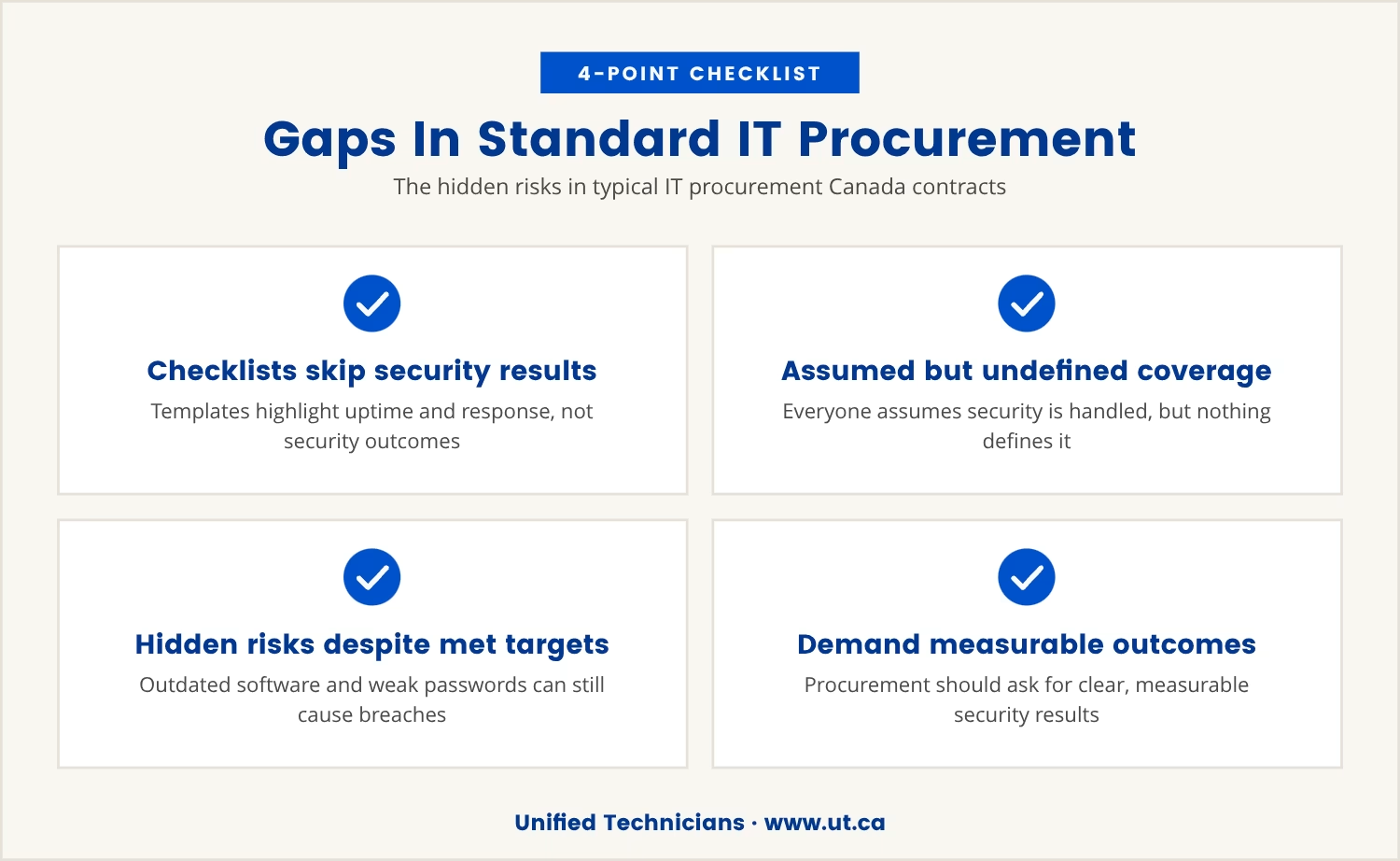
Procurement teams often rely on standard templates and checklists when sourcing managed IT services, and those documents usually highlight service levels for uptime and response while rarely spelling out the security results the business actually expects.
That gap creates a situation where everyone assumes security is covered, but no one has defined what that means in practice. A contract might require the provider to respond to incidents within an hour, for instance, without specifying how they should prevent those incidents from happening at all.
When expectations stay vague, providers tend to deliver only what is measured. That means your business could meet every uptime target and still face risks from outdated software, weak passwords, or unmonitored network activity — the issues that most often lead to breaches and losses.
Procurement, then, needs to move beyond generic requirements and ask for clear, measurable security outcomes. Otherwise, you may find out too late that your contract left you unprotected exactly where it mattered most.
How managed IT services Ontario contracts should define security outcomes
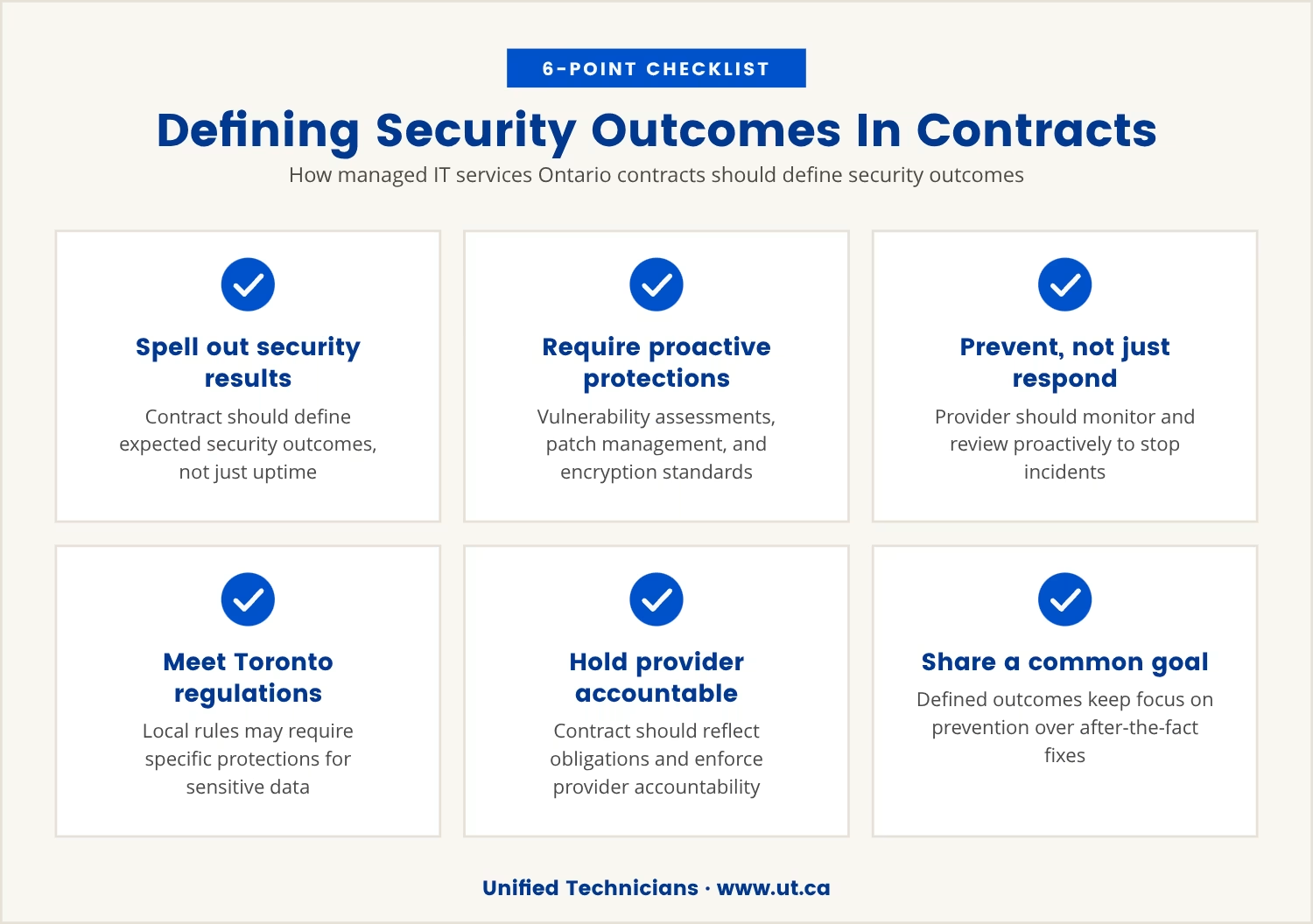
A managed IT services Ontario contract that truly lowers risk goes beyond uptime and response: it spells out the specific security results your business expects, so both you and your provider know what success looks like.
That means including requirements like regular vulnerability assessments, documented patch management, and clear standards for data encryption. Rather than asking only for a quick response to incidents, your contract should require your provider to prevent those incidents through proactive monitoring and regular security reviews.
For businesses in Toronto, this approach carries particular weight, since local regulations and industry standards may require you to protect sensitive data in specific ways. Your contract should reflect these obligations and hold your provider accountable for meeting them.
Once security outcomes are defined in the contract, you and your provider share an understanding of what needs to be achieved — which keeps the focus on preventing problems, not just fixing them after they occur.
Key elements of a security-focused managed service provider agreement
A contract that protects your business from risk includes more than uptime and response metrics. The elements below are what actually carry that protection:
- Clear security objectives: Define what a secure environment looks like for your business, including protection of sensitive data and compliance with regulations.
- Proactive monitoring: Require your provider to watch for threats and unusual activity, not just respond after something goes wrong.
- Regular vulnerability assessments: Schedule ongoing checks for weaknesses in your systems and require prompt action to fix them.
- Patch management: Ensure your provider is responsible for keeping all software and systems up to date with the latest security fixes.
- Incident prevention and reporting: Set expectations for how your provider will prevent incidents and how they must report any issues that do occur.
- Measurable outcomes: Use specific, trackable goals for security performance, so you can hold your provider accountable.
Together, these elements shift the focus from simply keeping systems online to actually protecting your business from the threats that matter most.
What happens when security outcomes are missing
When contracts skip over security outcomes, businesses often discover their exposure the hard way. A provider can meet every response time and uptime target, and still, if they are not actively working to prevent threats, your business remains at risk.
A ransomware attack can lock your data even when your systems are available, and your provider responds quickly, since the real loss comes from the breach itself, not from the time it takes to restore service. Without clear security requirements, your provider may bear no responsibility for the gaps that allowed the attack to happen in the first place.
This is why availability alone is not enough. The true cost of a poorly defined contract is measured in lost data, damaged trust, and expensive recovery efforts, and businesses in Toronto and beyond need to demand more from their managed IT agreements.
How to align your contract with your business's real risks
To protect your business, your contract must reflect the risks you actually face. Start by identifying the data and systems that matter most to your operations, then work with your provider to define the security outcomes that will keep those assets safe.
Ask yourself: does your current contract spell out what security success looks like, or does it only promise fast responses and high uptime? If you cannot answer that question with confidence, it may be time to revisit your agreement.
From there, bring in your internal staff and any relevant stakeholders, since their insights can surface gaps that a standard contract might miss. Make sure your provider is willing to commit to clear, measurable security outcomes, and hold them to it.
The bottom line: Security outcomes are the real measure of risk reduction
A managed IT services contract that focuses only on response times and uptime does not guarantee your business is safe. The real measure of risk reduction is whether your provider is accountable for delivering the security outcomes that matter to you.
By defining these outcomes in your contract, you move the relationship from fixing problems to preventing them, which keeps your business protected from the threats that cause the most harm rather than only the ones that are easiest to measure. We back this with guaranteed SLAs, and for businesses with 30+ employees, we offer a free 90-minute executive-level IT assessment that reviews stakeholder input, ticket history, and security basics to show where those outcomes currently stand.

How we help businesses with 50 to 200 users close security gaps
Many businesses with 50 to 200 users find themselves with managed IT contracts that promise fast responses but leave security outcomes undefined. At Unified Technicians, we see how this can put your business at risk.
If you want to know how we approach security-focused managed IT services, or want a conversation about your current setup, let’s talk.
Want to see security outcomes in action?
Try a 30-day free trial of our full managed IT services and see how a security-focused approach can protect your business before you commit.
Frequently asked questions
What should I look for in a managed services agreement to ensure my business is protected?
Look for clear, specific requirements around security, not just uptime and response times. Your agreement should include regular vulnerability assessments, proactive monitoring, and clear standards for how your data is protected, with the provider responsible for preventing incidents rather than only responding to them.
How does a managed service provider help with cybersecurity beyond just responding to incidents?
A managed service provider can help by monitoring your systems for threats, keeping software up to date, and conducting regular security reviews. Their role should include preventing attacks before they happen, not just reacting when something goes wrong — that proactive approach is what actually reduces your risk.
Why is it risky to focus only on uptime and response times in IT contracts?
Focusing only on uptime and response times means you might overlook the security gaps that lead to data breaches or other losses. While these metrics matter, they do not address the root causes of most IT risks, and a contract that ignores security outcomes leaves your business exposed.
What role should staff play in defining security outcomes with a managed IT provider?
Your staff can provide valuable insights into how your business operates and where sensitive data is stored or used. Involving them in the process helps ensure your contract addresses real-world risks rather than only technical requirements, and their input can produce a more effective agreement.
How can analytics improve the effectiveness of managed IT services?
Analytics can help your provider spot patterns and detect unusual activity that might signal a security threat. By analyzing data from your systems, they can identify risks early and act before problems escalate, which makes your IT environment safer and more reliable.
Alex Oosterman is the founder of Unified Technicians, bringing 12+ years of IT leadership and expertise in cloud technologies, cybersecurity, and business technology solutions.